You’ve moved in. Your first day is yours to shape.
Residents have persistent, fictional health courses. Bipolar mood episodes last across days and weeks; withdrawal is distinct from recovery. Symptoms vary between people. Clutter and changes in self-care build gradually and can improve. The game’s probabilities are not clinical prevalence or predictions. Sleep changes, pauses, unfinished tasks and requests for space are observations, not diagnostic tests. Individual symptom patterns vary. Everyday scenarios informed by Think it Through.Life; clinical background links use NIMH and MedlinePlus. Care decisions remain with the resident and their professionals.
After the introductory household day, everyday situations can arise from a resident’s current energy, sleep, attention, worry, or ongoing mood episode. Walk over to respond. Practical help requires doing a task and returning to check in. You can set a clear boundary; the household can make its own plans. These fictional situations involve teens and adults and do not predict how everyone with a condition behaves.
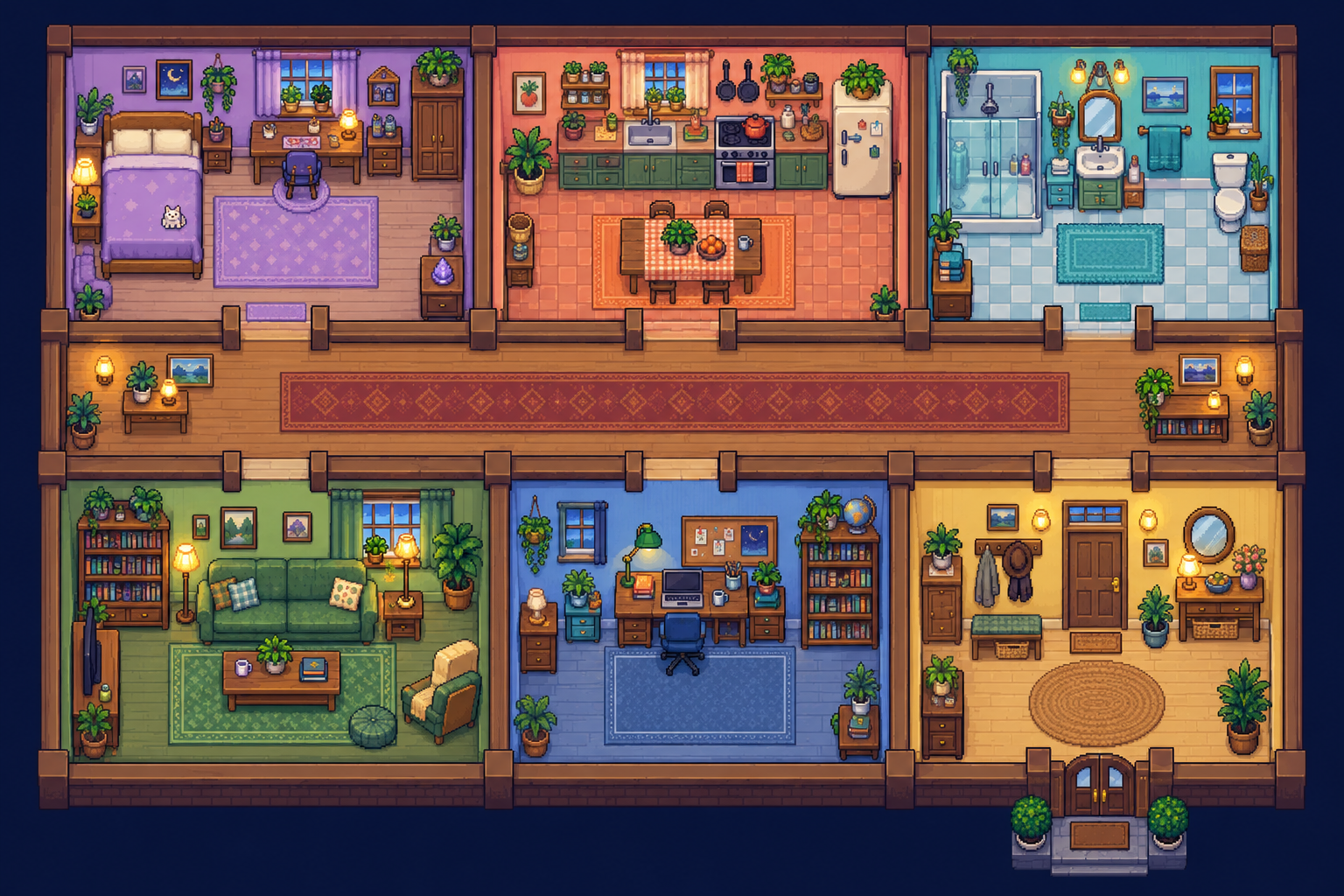
Click open floor to walk there. Click furniture or a housemate to choose an activity, then queue up to six activities. Your character walks through doorways, sits at furniture, cooks and eats, reclines to sleep, and showers with animated water. Housemates share table seats and arrange their own conversations. Conversations wait for a housemate to finish private or ongoing activities. Sleep has a short visible bedtime transition before morning starts. Pause and fast-forward control the whole simulation. Click Goals & house details for the journal, story progress, and house management. Auto-care optionally queues food, rest, or a shower when a need is low. You can still move with WASD or arrow keys, or use the touch controls. Manual movement cancels your queue. Press E near a room activity to interact. You can also click room labels for assisted movement. Café work is hands-on: select a customer, assemble the recipe on their ticket, and serve. Study and chores now take place directly in the house. Residents pursue their own evolving goals. Open Household pulse to see what they want and why they are acting. The guided household day is optional. Use Place furniture to buy an item and choose its floor space; Shift-click a placed item to relocate it for free. The house clock runs while you play. Pause or speed up beside the House / Neighborhood tabs. Residents autonomously choose activities and share furniture. No time passes while this tab is hidden or closed. Tasks also advance your clock.
A balanced day means you ate, hygiene stayed at least 40, and stress was 65 or less at bedtime. Setbacks never end the game.
Your game saves in this browser. New games roll supported profiles including depression, ADHD, anxiety, PTSD, bipolar I disorder, opioid use disorder, schizophrenia, OCD and ten personality-disorder categories, plus individual support preferences. Adult-only profiles are excluded for children and teens. This is a limited library, not every mental disorder. Profiles may repeat within a house. These equal game odds do not represent real-world rates. Assignments persist for the entire saved game; symptoms can vary without a diagnosis changing every day. Fictional characters illustrate a few possible experiences, not every person with a diagnosis. The game is not treatment or a clinically validated simulation. Its random probabilities are game balancing, not clinical prevalence or prognosis. Symptoms vary between people and across time; supportive conversations do not cure a condition. Residents manage their own professional care, and you are not their clinician. Background reading: NIMH mental health topics. Depression · ADHD · GAD · PTSD.
The housemates gather by the door. You take your routines, your skills, and a few good friendships with you. There will still be difficult days. Now you have a place to begin them.
This replaces your saved game on this device.
 YOU08:00